
Crypto Casinos for Aussies: Which Offshore Platforms Are Actually Worth a Deposit
 Available in AU
There is no such thing as an Australian-licensed crypto casino. Not one. Every platform that will take a Bitcoin deposit from a punter in Perth, or send a Litecoin withdrawal to a wallet in Brisbane, is operating from somewhere else under someone else’s paperwork. That single fact clears away most of the confusion in this market, and it is where an honest review has to start rather than with a countdown of shiny brands.
The useful map of the offshore crypto casino market for Australian players is built from measured payout timings instead of advertised ones, licence numbers checked in public registers, and bonus terms converted into the throughput they actually demand. Advertising supplies the percentages. Registers, complaint archives and a deposit slip supply everything else.

How these platforms were tested
Testing an offshore casino is mostly bookkeeping. Deposit, play, request a withdrawal, then write down what happened and when, including the parts the operator would prefer left out. Every timing in this review was either measured that way or taken from published editorial tests that describe their method, and where a brand’s advertising and its player complaints disagree, both numbers appear.
The axes that decide whether money actually moves are narrow: licence jurisdiction and a verifiable licence number, coins and networks supported, minimum deposit, real withdrawal time after approval, playthrough expressed as throughput rather than as a headline percentage, and the point at which identity checks switch on. Game library size gets a mention where it matters, but it is a weak signal. Every site in this bracket claims thousands of titles and most license the same dozen studios.
Australian gambling law is federal, uniform across the states, and enforced against operators rather than players. That distinction gets blurred constantly in forum arguments, and it changes what protections a punter actually holds, so it gets its own treatment here rather than a footnote.
None of this is a recommendation to gamble, and none of it is legal advice. It is a description of how twelve operating businesses behave when a customer asks for their money back.
Offshore crypto casinos are also not a stable category. Domains get blocked, brands migrate between licences, and a site that paid out in March can be hiding behind a verification queue in September. Twelve platforms currently accept Australian registrations, publish verifiable licence numbers, and have enough independent reporting on their payout behaviour to say something specific about them. Those twelve are what follows.
The best Aussie crypto casinos in 2026, in detail
Australian players can access offshore crypto casinos, and the practical decision is never whether to use one but which. The platforms in this review accept AU registrations, support either AUD account display or crypto-native balances, and differ mainly in how their banking behaves at the moment a withdrawal is requested.
| Operator | Licence | Withdrawal speed (measured) | Min deposit | Distinguishing feature |
|---|---|---|---|---|
| Wild Tokyo | Curaçao GCB (OGL series) | 5–30 min after approval | ~AU$20 equivalent | 250% up to AU$5,300 plus 600 free spins, daily promo cadence |
| Lucky7 | Curaçao GCB (OGL series) | ~30 min | ~AU$20 equivalent | 29 deposit and withdrawal rails across crypto, card and e-wallet |
| BitStarz | Gareton B.V., Curaçao OGL/2024/165/0185 | ~10 min average | 0.0001 BTC / ~AU$20 | Running since 2014 with published payout records and no withdrawal cap |
| Mino Casino | Curaçao GCB (OGL series) | Usually inside one hour | ~AU$20 equivalent | Reload ladder covering every day of the week |
| Nova Jackpot | Curaçao GCB (OGL series) | Up to 24 hours | ~AU$25 equivalent | Progressive jackpots as the primary identity, not an afterthought |
| Vave | Curaçao GCB (footer number), Anjouan cited on mirrors | Advertised 5–15 min; days when verification fires | 0.0001 BTC | 20+ coins plus a sportsbook vertical under one account |
| Stake | Curaçao GCB (Medium Rare N.V.), Anjouan secondary | Under 10 min where accessible | 0.0001 BTC | Biggest operator by revenue; Australia listed as restricted on the main product |
| BC.Game | Anjouan ALSI-202410011-FI1 | 10–15 min average | ~AU$10 equivalent | 150+ supported coins and the deepest in-house provably fair suite |
| CoinCasino | Curaçao or Anjouan, verify in footer | Under one hour typical | ~AU$10 equivalent | AFL, cricket and rugby markets alongside 2,000+ casino titles |
| Ricky Casino | Curaçao GCB (OGL series) | Reporting consistent with 1–24 hours | ~AU$20 equivalent | Pokies-heavy catalogue built around AU search demand |
| Crypto-Games | Curaçao GCB (OGL series) | Instant to under 30 min | Coin network minimum | Email-only sign-up; verification deferred to withdrawal |
| Metaspins | Curaçao or Anjouan, verify in footer | Up to 24 hours, frequently faster | $10 | Crypto-only rails with no fiat leg at all |
Before trusting any of those licence cells, work out what they prove. Curaçao rebuilt its regime: the old master-licence arrangement, where a handful of primary holders sold sub-licences on to whoever paid, was retired in favour of direct licences issued by the Curaçao Gaming Control Board. Those carry an OGL number in the format OGL/2024/165/0185, and that number is checkable. Copy it from the footer, look for the register entry, and note that the green badge a site displays is a link to that entry. A badge that goes nowhere is not a badge.
Anjouan works differently. The autonomous Comoros island issues ALSI-prefixed authorisations held in a separate register, with a shorter track record and a thinner complaint history behind them. Anjouan is not fake; BC.Game carries an ALSI number. It is a lighter tier, and it leaves a player one step further from any arbitration mechanism.
Neither register provides a dispute service an Australian player can invoke. A licence number confirms that an entity paid a regulator and passed basic probity checks. It does not create an ombudsman able to order a payout. The escalations that move operators in practice are public ones: Casinomeister and Casino Guru threads shift traffic, and an independent complaint record predicts whether you get paid better than any badge in a footer.

Wild Tokyo — widest promo cadence, with caps to match
Wild Tokyo is an offshore casino built for the Australian market: AUD account display, Curaçao GCB paperwork, a catalogue north of 3,000 games, and crypto rails carrying BTC, ETH, LTC, USDT and DOGE. Its welcome package leads the shortlist on paper at 250% up to AU$5,300 with 600 free spins, and the ongoing cadence is heavier than anything else in the Australian bracket, running reloads, tiered cashback in the 5–20% band, recurring spin and coin drops, and loyalty escalation toward AU$55,000.
That volume is why it sits near the top of AU-facing rankings and why the terms deserve reading before the claim. Complaint-handling records flag a withdrawal ceiling around €500 per day and €6,000 per month, which becomes a real constraint the moment a jackpot lands, and the playthrough on the headline offer is 50× inside five days. Multiply a AU$500 deposit by that requirement and the target is AU$25,000 of wagering in a working week. That is not a bonus so much as a deadline. Suited to a player who funds modestly, clears as they go, and treats the promo calendar as the product rather than the welcome headline.
Lucky7 — simplest wallet flow, broadest rail count
Lucky7, operating under the Lucky7even brand through a Curaçao-licensed entity, is the least friction-heavy site in the group for anyone moving between payment styles. Twenty-nine deposit and withdrawal methods mean a player can start on a card, switch to Litecoin, and finish on USDT without changing platforms. Casino and live dealer coverage is broad with pokies first, the welcome sits at up to AU$3,000 with 200 free spins, and a recurring Lucky Spin draw, weekly boxes plus 100% Monday and Saturday reloads stack underneath.
Editorial testing of the AU cohort puts its crypto cash-out at roughly half an hour, which is mid-pack rather than exceptional but consistent, and consistency is what makes a banking flow usable day to day. User-review volume is modest: a Casino Guru rating in the “Excellent” band on a few dozen reviews, so the reputation signal reads positive but thin. Reasonable first offshore account for a player wanting crypto rails without committing to a crypto-only interface.
BitStarz — the durability benchmark
BitStarz launched in 2014, which predates most of what now calls itself a crypto casino, and runs under Gareton B.V., a Curaçao company holding registration number 160656 in Willemstad with the direct GCB licence OGL/2024/165/0185 published in the footer. Game count exceeds 7,000, the coin list covers BTC, ETH, LTC, USDT, DOGE and BCH, the platform charges no withdrawal fee of its own, and there is no published withdrawal cap. That last point matters more than any bonus headline, because caps are where large wins go to die quietly.
The welcome package of 300% up to 5 BTC with 180 free spins is structurally heavier than it looks. At any sensible deposit the number that matters is the playthrough, which lands around 40×, not the ceiling. Independent testing reports an average crypto payout near ten minutes, and Trustpilot aggregation sits in the 4.4–4.7 band across roughly five thousand reviews, an unusual combination of volume and score in a category where both are rare. The recurring complaint theme is not withheld money but strict enforcement of one account per household, which has closed family-shared registrations with balances attached. If the same Wi-Fi in a share house covers two players, read that clause before depositing rather than after.
Mino Casino — the reload ladder over the headline
Mino is an offshore crypto-and-fiat casino aimed squarely at Australian demand: pokies and live tables, multi-coin banking, AUD display, and a Curaçao GCB licence with the number published for checking. The 250% up to AU$4,140 with 400 free spins welcome is competitive but is not the reason to look at it. The reason is the week. Tuesday Happy Hours runs 50% up to AU$540, Wednesday 30% up to AU$540 with 30 spins, a Power Reload adds 50% up to AU$450 with 50 spins, a Stamina offer sits at 15% up to AU$540, and a 7% daily up to AU$180 underpins all of it.
A player who funds an account weekly in small amounts rather than once in a large one extracts more from that structure than from a single inflated welcome, precisely because each rung is small enough to clear without gambling past the point of entertainment. Reported cash-outs usually land inside an hour. The trade is that a five-offer calendar means five sets of terms, and reading them is the homework. A bonus you cannot clear is not money; it is a voucher for a game you are obliged to play.
Nova Jackpot — jackpot-first in a pokies-heavy field
Nova Jackpot is the only brand in the AU top-five shortlists whose identity is progressive jackpots rather than a bonus number. The welcome offer runs 250% up to AU$3,750 with 250 free spins, live cashback pays 25% up to AU$300, a daily 15% up to AU$600 sits underneath, and networked jackpot events add promotional pools around major sporting calendars. Crypto support is multi-wallet across the standard majors plus stablecoins, and the catalogue covers crypto slots, live dealer and tables in the usual breadth.
It is also the slowest payout in this sample, with reported cash-outs taking up to 24 hours against 5–60 minutes elsewhere. For a jackpot hunter that is tolerable, since volatile games pay in lumps and rarely in a hurry. It is the wrong banking profile for anyone moving money in and out on a weekly rhythm. Choose it for the prize pools rather than the transfer speed.
Vave — coin breadth and a split reputation
Vave arrived in 2022 as a crypto-first casino and sportsbook under a Curaçao GCB licence, with some mirrors also citing Anjouan. The primary number sits in the footer and is worth confirming before a first deposit, because the two tiers are not equivalent. The offer reaches 4 BTC with 100 free spins and 5% cashback, supported coins run past twenty, and advertised processing is ten to fifteen minutes.
Reporting on Vave is where a review has to stop smoothing. Editorial polls describe the majority of test withdrawals clearing inside twenty minutes. The Trustpilot aggregate is 1.7 out of 5 across a couple of hundred reviews, dominated by verification holds and duplicate-account closures where balances were confiscated. Both statements can be true at once: fast when nothing flags, very slow when something does, and the flag is usually a second household member opening an account or a large win triggering source-of-funds questions. Play it with one clean account, verify early on your own schedule rather than when a withdrawal is pending, and treat the 3× deposit turnover rule before any cash-out as a hard gate.
Stake — the scale outlier, with an access caveat
Stake is the biggest business in crypto gambling by a wide margin: estimated gross gaming revenue above $4 billion for 2025, around 127 million monthly visits by traffic measurements, a Curaçao GCB licence through Medium Rare N.V., affiliated processing entities, a Formula 1 team title, and an in-house originals suite with live dealer content from Evolution and Ezugi. It is the institutional end of this market rather than the boutique end, and its liquidity, odds depth and provably fair tooling reflect that scale.
Which is exactly why the Australia line has to be read rather than assumed. Australia appears on Stake’s own restricted-territories list for the primary product, even though many AU-facing review pages still present it as available. Some of that confusion traces to the group’s Australian-linked corporate history and its streaming and sports-betting affiliates, which are separate products under separate terms. For a player in Sydney or Adelaide the accurate statement is blunt: the flagship platform does not open to you, any mirror that does is not the same product under the same paperwork, and a dispute on a mirror is not a dispute with the brand you think you are dealing with.
BC.Game — coin count and originals depth
BC.Game has run since 2017 and now carries an Anjouan authorisation, number ALSI-202410011-FI1, issued by the government of Anjouan in the Union of Comoros. Game count sits above 10,000, crypto support passes 150 coins, and its in-house originals of crash, dice, plinko and keno-style titles with verifiable hashing are the deepest set in this group. Payout reports sit in the 10–15 minute band, there is a four-tier welcome structure, a tiered VIP programme with rakeback, and a sportsbook with streaming.
Entry friction is soft: registration by email and password, with verification reserved for large or flagged withdrawals. Trustpilot sampling reads poorly in places, with scores in the 2.3 band on some regional portals driven by high-stakes dispute reports rather than by small-player experience. The licence tier is the honest caveat. Anjouan’s register is legitimate but younger and less trafficked than Curaçao’s reformed GCB system, so practical protection comes from the operator’s own volume and public complaint record rather than from the authorisation. Good fit for a player who wants many coins and verifiable in-house games; a worse one for anyone who wants a regulator they can complain to.
CoinCasino — the Australian-sport crossover
CoinCasino pairs a casino catalogue of 2,000+ titles with a sportsbook covering AFL, cricket and rugby, and that combination is rarer than it sounds. Most crypto casinos either skip the Australian football codes entirely or run a thin global sportsbook with no local markets. Coin support exceeds twenty including BTC, ETH, DOGE and SHIB, deposit minimums are low by category standards, and the welcome headline of 200% up to $30,000 with 50 Super Spins is the largest nominal figure in this group.
Large nominal figures deserve a calculator. A 200% match up to $30,000 is only relevant if a player deposits $15,000, which almost nobody does, and the terms attached to such offers are invariably the tightest in the portfolio. What CoinCasino actually suits is the punter wanting one account for the Friday night football line and the pokies set afterwards, funding both with a stablecoin so the balance is not exposed to a Bitcoin weekend. Verify the licence number in the live footer before funding; brands in this bracket have changed authorisation jurisdiction more than once.
Ricky Casino — high AU search interest, thinner public file
Ricky is one of the most-searched crypto casino brands from Australian ip ranges and appears consistently in AU roundups alongside BitStarz and Vave. Curaçao-licensed, pokies-weighted with Pragmatic Play, BGaming and Platipus content, crypto rails across the majors plus stablecoins, and welcome packaging in the AU$3,000–5,000 band with free spins attached.
The public record is thinner than the other names here, and that needs saying rather than papering over. Measured payout data from independent testers is sparse, complaint-volume patterns are harder to read, and the licence chain requires confirming on the live footer rather than trusting an aggregator’s screenshot. Not automatically a bad sign. Brands with heavy search demand and light editorial coverage are common in this market, because reviewers chase the names that pay commissions. It changes the deposit size a cautious player starts with: small first deposit, small first withdrawal, watch what the banking does before scaling up.
Crypto-Games — email address and go
Crypto-Games is the lowest-friction entry point in this review. Sign-up asks for email, username and password; no identity documents at the door and no proof-of-address request before a first spin. Crypto banking covers the majors and stablecoins, provably fair dice, crash and plinko sit in the lobby, a sportsbook is attached, and cash-outs return to the same coin used for the deposit. That last detail is small and saves an entire conversion fee.
“No KYC at sign-up” is not the same as “no KYC ever”, and the site is explicit about the difference. Verification can fire at withdrawal, most commonly when a single cash-out crosses roughly the two-thousand-dollar band or when stake patterns look unusual against turnover. VPN use is permitted outside a restricted-country list, and Australia’s position on that list should be checked at the moment of registration rather than from memory, because those lists move. Right end of the spectrum for a player who genuinely values privacy at entry and will verify later; wrong one for anyone planning to move five figures without paperwork.
Metaspins — the crypto-purist test case
Metaspins runs without fiat rails at all. No card deposits, no bank transfer, no e-wallet leg into traditional banking: balance in, play, balance out to an address you control. The welcome structure is 100% up to 1 BTC with 40× playthrough and a $10 minimum, coverage spans BTC, ETH, LTC, USDT and a spread of alts, casino and sports verticals run side by side, and a stated 24-hour window is frequently beaten according to independent reporting.
A no-fiat design is a technical choice rather than an aesthetic one. Fiat rails are where a casino inherits bank-side AML obligations, so removing them removes an entire layer of transaction-review paperwork, and equally removes the consumer-protection veneer those rails impose. Payouts are only as fast as the chain selected, which is why network choice matters more under this model than the operator’s own processing queue. Suited to a player already comfortable self-custodying coins; a poor first offshore experience for anyone who is not.
New entrants deserve a separate word. The category launches sites faster than any reviewer can test them, and “new crypto casino” is mostly a phrase people use when they mean “not the one I already play at”. Newly launched brands therefore appear in AU rankings alongside sites running since 2014, on data from the same week. The useful distinction is not age but public history. A year of independent payout measurements and a readable complaint archive is worth more than an extra two hundred titles.
What “legal” actually means for crypto casinos in Australia
The Interactive Gambling Act 2001 prohibits any person from providing online casino games to someone physically present in Australia. Pokies, roulette, blackjack and online poker all fall inside it. Section 15 carries the prohibition, the penalties are civil, and the Australian Communications and Media Authority enforces. The targets are operators. Not players.
That structure produces the situation Australian punters actually live in. No domestic licence exists for an online casino, so there is no white-list to check, no local regulator to complain to, and no prospect of an Australian-licensed crypto casino appearing at a URL near you. Fourteen casino licences exist nationally: Crown Melbourne, The Star Sydney, Treasury Brisbane, The Star Gold Coast, The Ville in Townsville, Reef in Cairns, SkyCity Adelaide, Crown Perth, Wrest Point and Country Club in Tasmania, Mindil Beach in Darwin and Casino Canberra. Every one covers a building you walk into. None extends online.
Are crypto casinos legal in Australia?
Offering online casino games to Australians is illegal under the Interactive Gambling Act 2001, which ACMA enforces against operators. Playing at an offshore crypto casino is not a criminal offence for the player. No online casino holds an Australian licence, so every site taking Aussie deposits is offshore and protections come from its foreign regulator.
ACMA’s enforcement kit has two visible parts. It publishes a register of illegal offshore gambling operators, and it can direct Australian internet providers to block domains. Blocking is the part players notice: a site that loaded last month returns an error, the operator registers a near-identical domain, and the cycle repeats. The practical consequence is that any bookmark can become a dead link with a balance behind it, which is a solid argument for withdrawing regularly rather than treating a casino balance as storage.
The state-by-state question comes up constantly and has a boring answer. Online casino prohibition is federal and uniform, so NSW, Victoria, Queensland, South Australia, Western Australia, Tasmania, the ACT and the Northern Territory sit in identical positions. State regulators handle land-based venues and, in some cases, locally licensed bookmakers. Sports betting with an Australian-licensed bookmaker remains lawful; in-play betting online does not, which is why phone and venue betting on live markets survives as a quirk of the drafting.
Two recent changes matter to crypto specifically. The June 2024 amendments to the Act banned licensed Australian wagering operators from accepting cryptocurrency or credit card payments, which is why no legal AU bookmaker will take a Bitcoin deposit: the coin rails and the licensed rails are now separated by design rather than by commercial choice. Separately, the Digital Assets Framework Bill tabled on 1 April 2026 pushes exchanges and custody platforms toward an AFSL regime with an eighteen-month transition, with AUSTRAC continuing as gatekeeper in the meantime. Neither reform creates a path to a licensed Australian crypto casino, and successive governments have debated that idea and shelved it rather than legislating it.
The gap most AU pages skip is BetStop. The National Self-Exclusion Register covers Australian-licensed wagering providers, and it has no reach into a Curaçao-licensed casino that never appears in the Australian system. Registering blocks licensed bookmakers from opening an account for you or contacting you; it does nothing about an offshore cryptocurrency casino. A player who self-excludes and then finds an offshore site still open has not found a loophole in the register. They have found the edge of its jurisdiction. Self-exclusion on an offshore platform must be requested from that platform directly, and enforcement depends entirely on the operator’s own systems.

No KYC versus verified — when the ID check actually fires
Most crypto casinos do not ask for identity documents at sign-up. Almost all of them reserve the right to ask before a withdrawal leaves. Those two sentences describe the market better than the phrase “no KYC casino” ever has, and a player who reads the first without the second is the player who ends up posting an angry review.
| Verification level | Typical trigger | Documents required |
|---|---|---|
| Anonymous entry | Registration and play; deposits of any size | Email address, password, sometimes only a wallet connection |
| Standard KYC | First withdrawal above roughly AU$2,000–$10,000, or cumulative turnover crossing an internal threshold | Photo ID, selfie holding the ID, proof of address dated within three months |
| Enhanced due diligence | Withdrawals above roughly AU$10,000, rapid win escalation, multiple accounts or wallets, irregular stake patterns against deposits | Source-of-funds evidence: payslips, bank statements, exchange transaction history, tax records |
The dollar figures vary by operator and by the risk engine behind it, which is why they appear as bands rather than precise numbers. What does not vary is the shape of the thing: the check is deferred, not removed, and it is triggered by money leaving rather than money arriving. Crypto-Games documents this openly. BC.Game runs the same structure with softer entry. Vave’s complaint archive is essentially a record of what happens when the check fires on a player who did not expect it.
Do I need to verify my identity to play at a crypto casino?
Rarely at sign-up, often before a large withdrawal. Most offshore crypto casinos let you register with an email address and play immediately, then request photo ID, a selfie and proof of address when a cash-out crosses an internal threshold, commonly a few thousand dollars, or when account activity triggers an AML review.
Which leads to advice almost no comparison page gives. Stop asking whether a site is no-KYC and start asking at what point it stops being one. Then verify on your own timetable. Uploading a passport scan on a Tuesday afternoon with nothing pending is administrative housekeeping. Uploading it while AU$8,000 sits frozen in a pending queue is a negotiation where the other party holds the money and controls the clock. Verification queues stretch under load, and they stretch most during exactly the periods when many players are withdrawing at once.
Documentation mismatch is the other predictable trigger. Crypto casinos flag accounts where the name on the ID differs from the name attached to the exchange account funding it, where the address on a utility bill is three years old, or where two accounts share a household IP. None of those are fraud. All of them stall withdrawals for days. Spending ten minutes confirming that the documents you would upload are current and internally consistent removes most of the risk of a hold, and it costs nothing.
Anonymity has a ceiling worth naming. Depositing from a centralised exchange account that already holds verified identity means the transaction is traceable end to end regardless of what the casino asks for. Genuine anonymity requires a self-custodied wallet funded through means that are themselves not identity-linked, which is a different project with its own complications. For the ordinary player, “no KYC” means less paperwork and faster onboarding. It does not mean invisibility.
How fast is “instant” — withdrawals in practice
A crypto withdrawal has two clocks running in series, and conflating them is why advertised speeds and player experience diverge so sharply. Clock one is the operator’s internal approval: risk review, bonus-condition check, verification status. Clock two is the blockchain. The first can take seconds or a fortnight. The second is a matter of network mechanics and is the only part anyone can predict reliably.
| Coin | Deposit confirmation | Withdrawal after approval | Typical network fee | Fastest available network |
|---|---|---|---|---|
| Bitcoin (BTC) | 10–60 min (1–6 confirmations) | 10–60 min | Cents at quiet times, dollars under congestion | Base chain only; Lightning rare at casinos |
| Ethereum (ETH) | 2–10 min | 2–10 min | Gas-dependent, low single dollars to well above | Ethereum mainnet |
| Litecoin (LTC) | 2.5–15 min | 2.5–15 min | Fractions of a cent | Litecoin mainnet |
| USDT (TRC-20) | 1–3 min | 1–3 min | Under a cent | TRON |
| USDT (ERC-20) | 2–10 min | 2–10 min | Several dollars, spiking with gas | Ethereum mainnet |
| USDT (BEP-20) | 1–5 min | 1–5 min | Cents | BNB Chain |
| Dogecoin (DOGE) | 1–10 min | 1–10 min | Fractions of a cent | Dogecoin mainnet |
| TRON (TRX) | 1–3 min | 1–3 min | Under a cent | TRON |
| Solana (SOL) | Under a minute | Under a minute | Under a cent | Solana mainnet |
How long do crypto withdrawals actually take and what fees will I pay?
Approval usually takes minutes at well-run sites and hours where verification is pending. Once approved the chain decides: Solana and TRON settle in under a minute for fractions of a cent, Litecoin in about fifteen, Bitcoin in ten to sixty with fees swinging from cents to dollars. Most casinos charge no platform fee.
The stablecoin point is the one worth internalising, because it is the largest avoidable cost in crypto gambling and almost nobody mentions it. USDT is a single token that exists on multiple networks. Send it over TRC-20 and the transfer costs a fraction of a cent and settles in a minute or two. Send the identical amount of the identical token over ERC-20 and the cost is measured in dollars, with gas spikes pushing it higher during Ethereum congestion. Same casino, same coin, same zero platform fee, and a cost difference of several orders of magnitude driven entirely by a dropdown menu most players click through without reading.
Run the arithmetic on a modest habit. A player depositing and withdrawing twice a month on ERC-20 at a few dollars each way spends in the region of $150 a year on network fees, since twenty-four transfers at roughly six dollars each is $144. The same pattern on TRC-20 costs less than a coffee across the whole year. That gap is larger than most cashback programmes return, and closing it requires no loyalty tier, no playthrough and no negotiation. Just selecting the right network on both sides of the transfer.
Two mechanical warnings attach. The network must match at both ends: USDT sent over TRC-20 to an address expecting ERC-20 is generally unrecoverable, and no support ticket fixes it. Bitcoin’s fee market is genuinely volatile, with quiet periods putting median fees in the fractions-of-a-dollar range while inscription-driven congestion has pushed costs to levels that make small withdrawals uneconomic. Withdrawing AU$50 in BTC during a spike can hand a meaningful slice of it to miners.
Measured reporting separates the operators cleanly on this axis. BitStarz averages around ten minutes, BC.Game ten to fifteen, Wild Tokyo five to thirty, Mino inside the hour, Nova Jackpot up to a day, and Vave either very fast or very slow depending on whether verification fires. The consistent performers share one trait: they approve first and rarely batch. The slow ones are slow at the approval stage, not on the chain.
Which coin to use, and why the answer is usually not Bitcoin
Bitcoin is the default because it is the name everyone knows, and for casino banking specifically that default is mediocre. Ten-minute blocks, a fee market responding to demand from an entire global settlement network you are not part of, and price volatility that can move a balance several percent while a player sleeps. It works. It is rarely the best tool on the menu.
Which cryptocurrencies can I use at an Aussie crypto casino — is Bitcoin the best choice or should I use USDT or Litecoin?
Nearly every crypto casino accepts BTC, ETH, LTC, USDT and DOGE, and broader platforms support well over a hundred coins. For casino use, USDT on the TRON network offers the cheapest and fastest transfers while holding its dollar value between sessions. Litecoin is the best non-stablecoin choice. Bitcoin is the slowest and most fee-variable.
Volatility is the underrated part of this decision, because it cuts both ways and most players notice only one direction. Deposit AU$1,000 in Bitcoin, play for three days without touching the balance, and the amount withdrawable in Australian dollars may have moved ten percent either way without a single spin contributing to it. That is a second wager layered silently on top of the first. Stablecoins remove it. USDT and USDC hold a dollar peg, so the balance deposited is the balance held, and the only remaining variable is the game.
For a player who wants exposure to coin price movement, that exposure belongs in a wallet or an exchange account, not in a casino balance where it sits alongside playthrough conditions and withdrawal caps. Separating the two is straightforward: hold whatever you like in your own custody, move stablecoins into play when you play, move them back out afterwards.
Litecoin deserves more attention than it gets in this market. Two-and-a-half-minute blocks, fees in the fractions of a cent, near-universal support across casinos accepting cryptocurrency, and no smart-contract layer to complicate anything. It is Bitcoin’s mechanics with the friction removed, and for players wanting a non-stablecoin option it is the sensible pick. Solana and TRON are faster still and cost essentially nothing to move, with support narrower but growing. BC.Game’s hundred-and-fifty coin list covers effectively everything a player might hold; smaller operators stick to the majors.
One constraint shapes all of this: most casinos require withdrawals in the same coin as the deposit. Choosing a coin is therefore a round-trip decision rather than a one-way one, and a player who deposits into a coin the site supports poorly will discover that at the withdrawal screen instead of the deposit screen.
Bonuses and free spins — what the headline actually costs
Casino bonus advertising is denominated in the units most flattering to the casino. Percentages and ceilings look enormous. Playthrough requirements, the numbers that determine whether the money is reachable, appear in smaller text, and game weighting, which can multiply the real cost tenfold, usually appears in a separate terms page entirely.
Converting a headline into throughput takes one multiplication and changes the picture completely.
| Operator | Headline welcome | Playthrough | Game contribution | Practical note |
|---|---|---|---|---|
| Wild Tokyo | 250% up to AU$5,300 + 600 free spins | 50× within 5 days | Pokies 100%, tables heavily reduced | Five-day clock plus reported €500 daily and €6,000 monthly ceilings |
| BitStarz | 300% up to 5 BTC + 180 free spins across first deposits | Around 40× | Pokies 100%, tables reduced | No withdrawal cap published; playthrough is the only real gate |
| Mino Casino | 250% up to AU$4,140 + 400 free spins | Mid-range offshore standard | Pokies 100% | Weekly reload ladder often returns more than the welcome |
| Nova Jackpot | 250% up to AU$3,750 + 250 free spins | Mid-range offshore standard | Pokies 100%, jackpot titles may be excluded | Check jackpot exclusions before chasing progressives on bonus funds |
| Vave | Up to 4 BTC + 100 free spins + 5% cashback | 3× deposit turnover before any withdrawal | Casino play counts | Turnover gate applies to deposits, not only to bonus funds |
| Metaspins | 100% up to 1 BTC | 40× | Pokies 100% | $10 minimum makes small-scale testing cheap |
| CoinCasino | 200% up to $30,000 + 50 Super Spins | Mid-range offshore standard | Pokies 100% | Ceiling only reachable on a five-figure deposit |
Work an example through. A AU$200 deposit on a 250% match yields AU$500 in bonus funds, and at 50× that is AU$25,000 of turnover before anything becomes withdrawable. On pokies at full contribution that is 25,000 of actual wagering. On table games counting at 10%, the same requirement becomes AU$250,000 of wagering: the identical bonus at ten times the cost, decided entirely by which tab of the lobby you play in. Add Wild Tokyo’s five-day window and the requirement stops being a target and becomes a schedule.
Which is why a 200% offer capped at $30,000 can be worse value than a 100% offer capped at 0.5 BTC. The ceiling is irrelevant unless a player deposits enough to reach it, and nobody funding AU$100 cares whether the cap reads AU$5,000 or AU$30,000. What matters is the multiplier, the contribution table, the time limit, and whether a maximum cash-out clause quietly caps what leaves the account regardless of what was won.
The “free” spins deserve their quotation marks. They are not free. They are a marketing expense the casino has already priced into the playthrough attached to whatever they produce, and 600 of them tied to a 50× requirement in five days is not a present, it is a job with a deadline. A casino is a business carrying a mathematical edge and a rent bill, not a charity distributing entertainment to strangers. Every promotional dollar in this market is an acquisition cost calculated to be recovered with margin, and the terms exist precisely to make sure of it.
No-deposit offers follow the same logic in miniature: small amounts, high multipliers, tight maximum cash-out caps, and a purpose that is account registration rather than player profit. Worth claiming as a way to test an interface at no cost. Not worth choosing a casino over.
Pokies, live tables and provably fair originals
Pokies are what most Australian players come for, and crypto casinos serve them from the same studios as everywhere else: Pragmatic Play, BGaming, Hacksaw, Platipus, Push Gaming, Nolimit City. Classic three-reel machines, video slots, Megaways mechanics, Bonus Buy options, progressive jackpot networks. A library of 7,000 at BitStarz and 10,000 at BC.Game draw from overlapping catalogues, so the difference is curation rather than access to unique content.
Live dealer runs on Evolution and Ezugi feeds across most of the shortlist, which means the tables an Australian player sees are the same physical studios serving Europe. What differs is stake ranges and table availability by hour. Australian evening play falls in a quiet window for European studios, and table selection thins accordingly.
The genuinely crypto-native category is originals: crash games including the Aviator format, dice, plinko, mines and limbo, built in-house and settled with a verifiable hash rather than a certified random number generator. BC.Game has the deepest set, Stake built the format, Crypto-Games runs a solid version. These games do not exist in the Australian regulated market in any form, which makes them the clearest functional difference between a crypto casino and anything domestic.
Are crypto casino games provably fair and how can I verify the outcome myself?
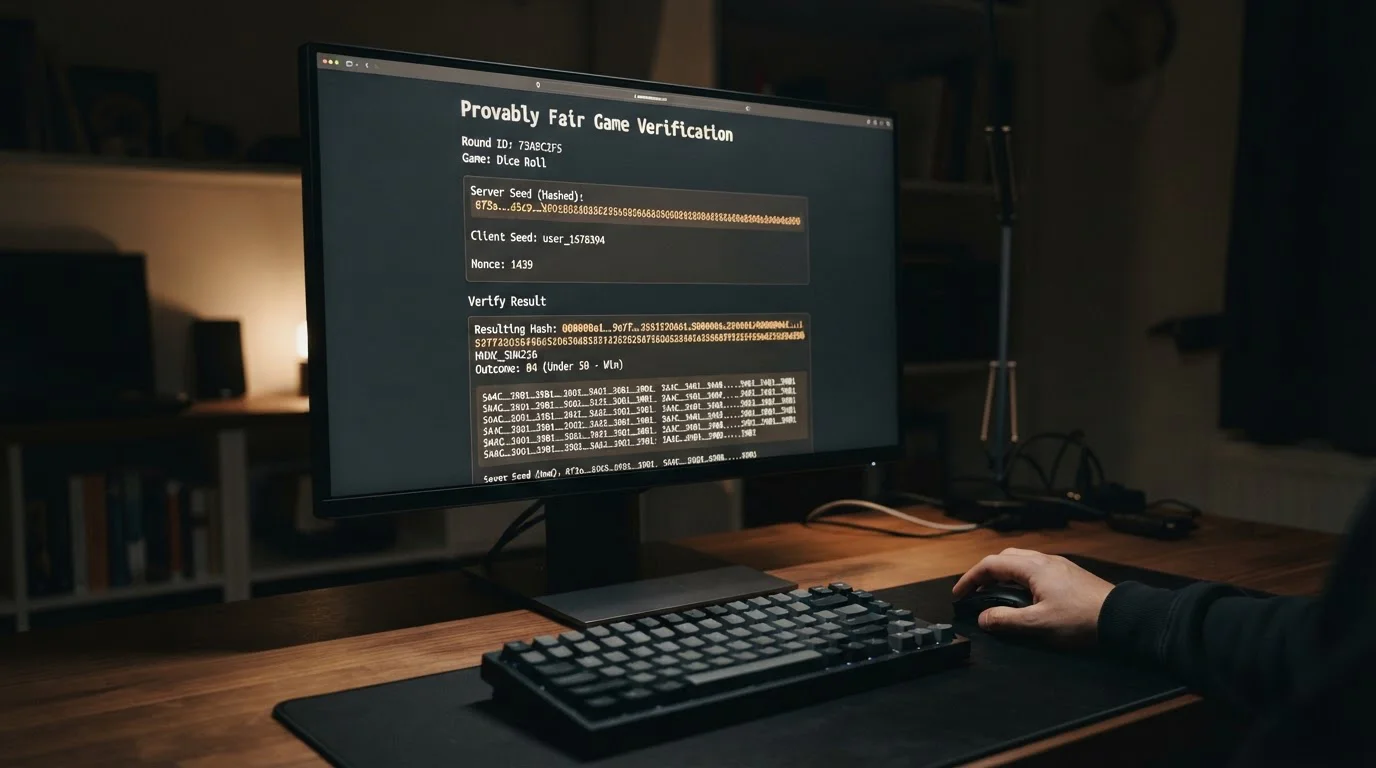
Only the in-house originals are. Before a round the casino publishes a hashed server seed; you supply a client seed; the result derives from both plus a nonce. Afterwards the server seed is revealed and you recompute the SHA-256 hash to confirm it matches. Studio pokies use certified RNG instead.
That workflow is worth doing once properly rather than trusting a badge. Set a client seed you chose yourself instead of accepting the generated default, since that is the step which makes the scheme meaningful: it prevents the operator selecting both inputs. Play a round. Rotate the seed, which triggers reveal of the previous server seed. Hash the revealed seed and compare it against the commitment published before you played. If they match, the outcome was fixed before the bet and could not have been altered by the result.
What that proves is narrow and worth stating precisely. The specific round was not manipulated after you committed to it. Nothing follows about the house edge, which sits in the game’s maths exactly as advertised. A provably fair crash game with a 1% edge takes 1% over time with complete mathematical honesty. Verification protects against cheating, not against losing.
Licensed studio pokies work differently and cannot be verified this way. Their randomness comes from a certified generator tested by independent laboratories, with RTP published per title, commonly in the 95–97% band and occasionally configurable by the operator within a range the studio permits. Checking the displayed RTP on a specific title before playing is worth ten seconds; the same game can ship at 96.5% or 94% depending on which configuration a casino licensed.
Can I play crypto pokies on my phone, and are mobile crypto casinos safe?
Yes, and mobile is the default for most Australian players. Nearly every platform in this review runs in a mobile browser without an install, though BC.Game offers a native app. Security depends on the same factors as desktop: HTTPS, two-factor authentication, a screen lock, and recovery phrases never stored on the phone.
Wallets, first deposits and the mistakes that cost money
Getting money into a crypto casino requires a wallet you control, coins in it, and a correctly matched network at both ends. That is the entire process, and the failure modes concentrate on the third step.
Wallet choice splits along a simple line. Custodial exchange accounts, the Australian exchanges most people already use, are convenient and already verified, and they mean the exchange holds your keys and sees your transactions. Self-custody wallets put the keys on your device and the responsibility on you. For casino use the practical middle path is a self-custody hot wallet holding only play money, funded from an exchange, with long-term holdings kept somewhere else entirely.
Which crypto wallet is best for playing from Australia, and what mistakes should I avoid on my first deposit?
Any reputable self-custody wallet supporting your chosen network works, because the wallet matters less than the discipline. The three costly mistakes are sending on a mismatched network, typing an address instead of copying it, and withdrawing to an exchange deposit address that does not support the coin or network you selected. Each is unrecoverable.
The first-deposit routine that avoids all three takes about two extra minutes. Copy the casino’s deposit address rather than retyping it. Check the first four and last four characters after pasting, because clipboard-hijacking malware exists and swaps addresses silently. Confirm the network selector in your wallet matches the network the casino specified: TRC-20 to TRC-20, ERC-20 to ERC-20. Send a small test amount first if the deposit is large. Then confirm the amount clears the casino’s minimum, because deposits below it can sit uncredited.
Two rules apply at the withdrawal end. Most sites require cash-out in the coin deposited, so the coin decision is made once and binds both directions. And if funds are heading to an exchange rather than a personal wallet, confirm that exchange accepts that coin on that network. Sending TRC-20 USDT to an address that only supports ERC-20 is one of the more common ways players lose money permanently, and the exchange’s support team cannot reverse it either.
One operational habit is worth adopting above all others: do not use a casino as a wallet. Balances left on offshore platforms are exposed to domain blocking, account closure, verification disputes and the operator’s own solvency. Withdraw winnings when they arrive, keep deposits sized to what you intend to play, and treat the casino balance as a session float rather than as storage.
Staying in control, and where the help lines actually are
Crypto gambling removes friction by design. Deposits clear in seconds, no bank appears between the impulse and the spin, and the balance reads in coins rather than dollars, which makes losses feel abstract in a way a debit card statement never does. That is not an accident of the technology. It is the product working as intended.
The tools that push back are mostly operator-side, and offshore operators vary wildly in how seriously they implement them. Deposit limits, session timers, loss limits and cooling-off periods exist on most platforms in this review. Account closure on request is the strongest of them and the only one that cannot be quietly reversed by clicking a confirmation email. Set limits when opening an account rather than when feeling they are needed, because the moment you need them is the moment you are least inclined to configure anything.
BetStop’s limitation deserves restating here, since it is the single most consequential gap for Australian players. The National Self-Exclusion Register covers Australian-licensed wagering providers. Offshore crypto casinos sit outside it entirely. A player who has self-excluded domestically and finds offshore sites still accessible should read that as a warning about where they are, not as an option that remains open. Gambling Help Online and the national helpline on 1800 858 858 work regardless of which platform the money went to, and they do not ask whether the operator was licensed.
Will I pay tax on crypto casino winnings in Australia?
Recreational gambling winnings are not assessable income in Australia, so the win itself is not taxed. Winnings received as cryptocurrency become an asset with a cost base equal to their Australian dollar value at receipt, and later selling, swapping or spending those coins is a capital gains event on any change in value since then.
That distinction catches people out, and it is the part no gambling page explains. Win 0.1 BTC when Bitcoin sits at AU$150,000 and the cost base is AU$15,000. Hold for four months, sell when Bitcoin reaches AU$180,000, and the disposal returns AU$18,000, so the capital gain is AU$3,000: assessable, and entirely separate from the gambling win that was not. Swapping coins for another cryptocurrency counts as a disposal too, as does spending them. Records of the date and Australian dollar value at receipt are what make that calculation possible later, and reconstructing them from an offshore casino’s transaction history months afterwards is unpleasant. This is general information rather than tax advice; anyone with meaningful sums should confirm their position with a registered tax agent, using the ATO’s guidance on crypto asset disposals as the primary reference.
What happens if an offshore crypto casino refuses to pay my winnings?
Your options are limited and none of them are Australian. No domestic regulator has jurisdiction, and ACMA enforces against operators rather than recovering player funds. Escalation runs through the operator’s complaints process, then its licensing authority in Curaçao or Anjouan, then public mediation services such as Casino Guru, whose leverage is reputational rather than legal.
Which is the argument for doing the boring work before it matters. Verify early rather than under pressure. Keep one account per household and never share a device or connection with another player’s account. Withdraw regularly instead of accumulating a large balance on someone else’s server. Screenshot the terms that applied when a bonus was claimed, because terms pages change without notice and a dispute turns on what was published at the time. And size deposits to what you would be relaxed about losing entirely, not to what you hope to turn into something larger. That second instinct is the reasoning that keeps this industry in business.
Crypto Casinos Australia 2026 — Bitcoin, Ethereum, USDT Compared
Content created by the «PayCasino» team