
Mastercard at Australian Pokies: The Cashier Reality Check 2026
 Available in AU

The card in your wallet has not changed. The rules around using it to fund casino play from Australia have, twice, in the past thirty months. Licensed betting sites stopped taking credit cards on 11 June 2024. A second reform package cleared Parliament on 19 August 2026 and switches on from 1 January 2027, reaching further into advertising, inducements and the payment pipes that feed offshore operators. Meanwhile the pokies sites that Australian players actually put card details into have never been licensed here, and never will be under the current federal statute.
That tension is the whole story behind a Mastercard deposit. It works, the transaction lands in seconds, and nobody phones you to complain. It also sits on ground that has been getting narrower for two years, run by operators with no Australian licence, through card rails that treat gambling as a special case. Eight AU-facing casinos that take Mastercard are set out below with what each cashier charges, how long money takes to come back, where the credit-versus-debit line genuinely falls, and what happens at the point your bank says no.
The Short Version: Mastercard, Australian Law, and Your Bank
Can you still use a Mastercard to play online pokies from Australia? Yes, and the reason is a detail of who the law is aimed at. The Interactive Gambling Act 2001 makes it unlawful for a provider to offer prohibited interactive gambling services to people located in Australia, which covers online casino games such as pokies, roulette and blackjack. The prohibition attaches to the supplying side. There is no federal offence for an individual who opens an account and deposits, which is why offshore casinos keep taking Australian card payments while being unable to advertise them here.
The enforcement sits with the Australian Communications and Media Authority. ACMA tells internet service providers to block addresses, fines companies, and can refer the directors of offending operations to the Australian Border Force for a movement alert, a quiet way of making travel to Australia inconvenient. Since November 2019 the blocking list has grown past 1,750 gambling and affiliate addresses, and roughly 230 services have pulled out of the Australian market rather than fight it. In the quarter running October to December 2025 alone, ACMA reported blocking 133 sites, many of them mirror addresses set up to step around earlier blocks.
> Banned services must not be advertised in Australia. They also must not promote or offer credit for online betting. — ACMA, About the Interactive Gambling Act
That second half matters more than it looks. The credit prohibition became explicit and specific on 11 June 2024, when the Interactive Gambling Amendment (Credit and Other Measures) Act 2023 came into force. From that date, licensed wagering operators in Australia cannot accept a credit card, funds linked to a credit card through a digital wallet, or digital currency as a deposit method. ACMA took sharper enforcement teeth in the same package. The law reads as a settled policy position: borrowed money does not belong in a betting account.
So which rules reach a player standing at a Mastercard cashier today?
One provision inside that same reform package reaches card players harder than anything in the advertising debate, and almost nobody writing about Mastercard casinos has mentioned it. The 2026 amendments place obligations on financial institutions to block transactions connected to illegal gambling services. Read that next to the 2024 credit ban and the direction is unmistakable. The earlier rule told licensed operators not to take credit. The newer rule tells the Australian banking system to stop money moving toward services that should not be serving Australians at all. The first is a permission problem for the merchant. The second is a routing problem for your deposit, and routing problems are exactly what a declined card is.
None of this is a forecast that card deposits disappear on 1 January 2027. The prohibition on offering casino services to Australians has been on the books since 2001 and offshore cashiers kept functioning through every round of tightening, helped along by virtual private networks and the simple commercial fact that acquiring banks in other jurisdictions are not bound by ACMA. But it does change how much you should rely on a single funding rail, and it is the reason the fallback structure of a cashier matters more than the size of its welcome offer.
Three practical consequences follow. First, debit is the clean path. A Mastercard debit deposit spends money you already have, gets no interest, and carries no cash-advance coding, and it is the method the market converged on once credit went out of favour everywhere else. Second, credit is a grey zone rather than a bright line. The June 2024 ban names licensed wagering operators, not offshore casino cashiers, so a credit deposit at an unlicensed casino is not blocked by that statute. What blocks it is your bank, which can refuse merchant category 7995, and your card agreement, which almost certainly treats a gambling transaction as a cash advance with interest running from the moment of authorisation. Third, nothing about playing offshore is protected. If a Curaçao-licensed operator withholds a payout, Australian regulators can pressure the site’s address but cannot make the company pay you.
Is it legal for Australians to play at offshore casinos that accept Mastercard?
Yes, in the narrow sense that federal law targets the operator rather than the player. The Interactive Gambling Act 2001 makes it unlawful to provide prohibited online casino services to people in Australia, not unlawful to use them. No Australian is prosecuted for depositing. The real exposure is civil: offshore sites hold no Australian licence, so local dispute and consumer-protection channels do not reach them, and ACMA blocks their addresses instead.
Eight AU-Facing Casinos That Accept Mastercard, Ranked by How Their Cashier Behaves
Ranking these by bonus size would be pointless, because the headline offer is the least stable number on any casino page and the one most likely to be excluded when you fund with a card. Ranked instead on how the Mastercard rail behaves at deposit, how long the money takes to come back, and how much of the process you can read before you commit.
The list leans toward Curaçao because that is where the AU-facing casino market lives. Every one of these operators sits outside the Australian licensing regime, which is a fact about the market rather than a footnote someone hoped you would not notice. Read the terms, verify the withdrawal tab, and treat any site that blocks your funding method as a site that has told you something.
National Casino
The most frequently cited Mastercard option in Australian listings for good reason. National launched in 2021, runs under a Curaçao licence within a company group that operates a stack of sister brands, and carries a library north of 4,500 games with weekly races layered on top. The cashier is unremarkable in the best sense: card deposits credit in seconds, the interface groups Mastercard alongside bank transfer, the usual e-wallets and a crypto option, and the minimum sits at the low end of the market, typically AU$10 to AU$15 depending on the promotion you attached to the account.
What you should check before funding is the withdrawal tab, and specifically whether the card you deposited with is offered back as a cash-out method. Card refunds through gambling merchant categories are the wrinkle in this whole market; acquirers differ on whether they allow funds back to the source card, so operators hedge by defaulting to bank transfer. National’s broad provider mix, Play’n GO and ELK among them, is genuinely strong, but a big lobby does not fix a slow payout. Best suited to players who want one account with everything in it and are happy to cash out by wire.
Rocket Casino
Rocket and its sibling RocketPlay are the same operation wearing two skins, launched in 2021, Curaçao licensed, and the rarer thing in this segment: a casino and a sportsbook under one balance. That combination changes how the payment rails get maintained, because a sportsbook operation needs faster throughput and a more disciplined KYC process than a pokies-only site, and the plumbing carries over.
Deposits arrive instantly or within a minute in normal conditions. The positioning Australian listings give Rocket is speed on the way out, and among the brands here it is a reasonable default expectation rather than a promise, with card and e-wallet requests typically moving inside 24 to 48 hours once verification is complete. The catch is structural: you are playing a betting product from a jurisdiction where betting products are the ones being regulated hardest, and the sportsbook side is where an operator’s licensing posture gets tested. If you want pokies plus a flutter on the same funds, look at how the site handles identity checks before you deposit, not after.
Joe Fortune
Joe Fortune is the oldest-feeling brand in this list even though it is not, because it was built for Australia and has never really tried to be anything else. Curaçao licensed, running a RealTime Gaming core with Platipus and Nucleus support and Visionary iGaming on the live side, with promotions keyed to the Australian calendar and support that answers in your hours rather than a shifted timezone.
The payment story follows the RealTime Gaming pattern across the AU market, which is a useful shorthand: deposits are easy and cheap from around AU$10, cash-outs lean on bank transfer, and the card-refund path is inconsistent from account to account. Two to five days is the honest window for a bank wire here rather than the 24-hour figure some listings print. Where Joe Fortune earns its place is predictability. A site that has kept the same audience for close to a decade has either been well run or has been lucky, and the difference usually shows up in how support behaves when money is missing.
Ozwin Casino
Ozwin arrived in 2020 into a crowded AU-facing slot and took the low-entry position: minimum deposits from AU$10, free-spin promotions stacked on top of small bankrolls, RealTime Gaming slots plus Visionary live tables. Mastercard sits at the front of the cashier menu, and the deposit itself is the fastest transaction on the page.
Small deposits are where card processing economics become visible to you rather than to the operator, though. A AU$10 card transaction costs the site a fixed acquiring fee plus a percentage, and some cashiers recover that with a surcharge on low-value card deposits or exclude them from a match bonus. Read the promotion terms for the funding-method line. Payouts at Ozwin run through bank transfer as the default, typically one to three days, and the site’s AU$-facing support hours are a genuine advantage over the international generalists in this list when a verification document bounces.
PlayAmo Casino
PlayAmo has run since 2016 under a Curaçao licence and is the broadest cashier of the group, which is the main argument for putting it on a payment-method page at all. Cards, the standard e-wallets, prepaid products and crypto all live in one menu, alongside a game library pulling from NetEnt, Microgaming, Pragmatic Play and Evolution. For a Mastercard user the significance is fallback. If a card refund is unavailable on your account, you are not stranded waiting for a wire; you have rails already wired into the same balance.
That breadth comes with the usual trade. PlayAmo is an international product with an Australian audience rather than an Australian product, which shows in timezone, promotion naming and the sheer number of jurisdictions on the terms page. Minimums and maximums follow the market norm, AU$10 to AU$20 in and modest card limits, with VIP tiers loosening daily caps. Anyone who expects to move funds out on short notice should treat the multi-rail structure as the actual reason to open the account.
SkyCrown Casino
SkyCrown is the newest design language in this list, an early-2020s mobile-first build with Hacksaw and Pragmatic titles front and centre, gamified rewards on top, and a cashier deliberately laid out for thumb use. That last part is not decoration. Card payments on mobile are where declines concentrate, because 3D Secure pushes a browser challenge or an app prompt at an awkward moment, and a cashier that handles the interruption cleanly is worth more than an extra fifty games.
Expect a minimum around AU$20 on cards, which is higher than the entry brands here, and payout windows reported across the range from same-day on e-wallets to two or three days on transfer. A younger brand with a first-payout verification habit is a specific kind of friction: the identity check that arrives when you are already committed rather than when you sign up. Do the document upload on day one, before the first deposit, and most of the complaints about this group of sites evaporate.
BitStarz Casino
BitStarz has been running since 2014, which makes it the longest-serving name here, and it is the one genuinely built as a hybrid rather than a fiat site with crypto bolted on. Curaçao licensed under the framework that replaced the old master-contractor arrangement, with Pragmatic, Evolution and BGaming supplying the lobby. Its relevance to a Mastercard question is specific: it solves the cash-out problem rather than the cash-in problem.
Depositing by card is ordinary. Getting money back is where the hybrid design pays. Where a card refund is unavailable or slow, a crypto withdrawal sidesteps the acquirer entirely and settles in hours, and the operator’s long record means the mechanics are tested rather than theoretical. The trade-off is a compliance posture that leans harder on identity checks at withdrawal than several of the brands above, plus the general reality that converting winnings into a digital asset introduces a price move between payout and cashing out at your bank. If you want your Mastercard to be an entry door rather than an exit door, this is the cleanest structure for it.
Ignition Casino
Ignition breaks the pattern in the only way that is interesting on a payment page: the licence is Kahnawake rather than Curaçao, from 2016 onward, and the product is a poker room with casino attached rather than the reverse. Deposits typically clear in one to three minutes through the card rail, and the traffic Ignition draws from Australia is heavily poker-weighted, which changes what the cashier needs to handle.
Poker balances create more frequent, smaller movements in and out than a slots account does, and that volume is where payment rules get felt. Card refunds to a poker deposit can be restricted where the operator’s acquirer treats the wallet differently from the casino wallet. Read the cashier’s withdrawal list for your specific account type before funding, and be aware that the live-dealer and tournament structures here suit a different session pattern than the pokies brands above. For a card-first player who also wants a table with a human dealer, Ignition is the outlier worth testing.
| Operator | Licence | Withdrawal speed once verified | Minimum card deposit | Distinguishing feature |
|---|---|---|---|---|
| National Casino | Curaçao | 24–48 h e-wallet, 1–3 days bank wire | AU$10–AU$15 | 4,500+ games, weekly races, single balance |
| Rocket Casino | Curaçao | 24–48 h typical, faster on e-wallets | AU$10–AU$20 | Casino plus sportsbook on one Mastercard balance |
| Joe Fortune | Curaçao | 2–5 days, bank transfer default | AU$10 | Built for Australia, AU-hours support, RTG core |
| Ozwin Casino | Curaçao | 1–3 days bank transfer | AU$10 | Lowest entry, free-spin cadence for small bankrolls |
| PlayAmo Casino | Curaçao | Under 24 h e-wallet, 1–3 days wire | AU$10–AU$20 | Widest fallback rail menu including crypto |
| SkyCrown Casino | Curaçao | Same-day e-wallet, 2–3 days other | AU$20 | Mobile-first cashier that handles 3D Secure cleanly |
| BitStarz Casino | Curaçao | Hours on crypto, 1–3 days card/wire | AU$20 | Longest record, crypto exit when card refund is blocked |
| Ignition Casino | Kahnawake | 1–3 days, varies by wallet | AU$10–AU$20 | Only non-Curaçao licence here, poker-led |

How a Mastercard Deposit Actually Works, Step by Step
The mechanics are boring, which is the point. Log in, open the cashier, pick the card option, type the amount, enter the sixteen digits, expiry and the three-digit code on the back, then approve whatever your bank throws at you. The transaction authorises against merchant category 7995, the code that tells the card network a gambling merchant is asking for money, and the balance updates in seconds. Repeat deposits reuse the stored card details, encrypted on the operator’s side, which is why the second transaction feels faster than the first.
Three details separate a smooth cashier from an annoying one. The first is 3D Secure, the authentication step your issuing bank runs. Australian banks pushed hard toward mandatory app-based approval for card-not-present transactions, and a casino that handles the redirect cleanly will get your deposit through on the first attempt. A casino that drops you into a browser window mid-flow, especially on mobile, loses a share of deposits to nothing more than bad timing.
The second is the pending period. Some operators hold a card deposit as pending until the funds clear the acquirer, a matter of hours rather than days, and while a deposit sits pending some bonuses will not attach to it. Third, the currency of the transaction. An AUD-denominated cashier processing through an offshore acquirer may still produce a conversion spread on your statement, which is a fee you will not find in the casino’s terms.
Australian listings routinely describe deposits as “instant”, and the accurate version is that authorisation is instant and availability depends on the processor’s check. Practically, if the balance has not moved in five minutes, something failed quietly rather than slowly. A useful habit on a fresh account is to make the first deposit intentionally small, AU$20 to AU$30, and confirm that it settles and that the withdrawal tab is still showing a route back before you load a larger amount.
Funding-source checks sit quietly behind that first transaction. Operators with a functioning anti-fraud stack will match the cardholder name to the account name and may reject a card in someone else’s name even though the card itself would authorise. A second card added shortly after the first can trigger a manual review, especially where the two cards share a bank identification prefix but not a name. None of this is disclosed on the cashier screen, so the least surprising way to fund is one card, one name, one currency, with the documents for that card already uploaded.

What is the minimum deposit with Mastercard at Australian online casinos?
Most AU-facing cashiers set card minimums between AU$10 and AU$30, with AU$20 the common default and lower figures usually attached to a specific promotion. Maximums for a single card transaction commonly sit in the AU$1,000 to AU$5,000 range, with daily and weekly caps set by the operator rather than by the card network.
Getting Your Money Back, and Why the Card Sometimes Refuses
Here is the part of the search query that the listicles oversell. “Instant withdrawal to Mastercard” describes a transaction type that exists and is less available than the phrasing suggests. A refund to the source card requires the operator’s acquirer to permit outbound funds to a gambling merchant category, and network rules on this are restrictive enough that a meaningful minority of AU-facing casino cashiers do not offer the path at all. Their answer is a bank transfer, an e-wallet, or crypto.
That is not necessarily an obstruction. A wire to an Australian account takes one to three business days and lands in dollars you can spend anywhere; a card refund looks attractive on the cashier screen and then sits in the acquirer’s queue. The problem is only surprise, which is why the check belongs before the deposit: open the withdrawal tab and see whether the card is listed for your account. If it is missing, decide whether you are comfortable cashing out a different way, because most operators require funds to leave by the method they entered wherever that is technically possible.
Timing splits into three chunks people merge into one complaint. Verification takes as long as the documents take, and the first payout is where a site with KYC habits will ask for passport or licence, a utility bill, and for cards the last four digits plus a cropped statement. Processing is the operator’s internal review, commonly 24 to 48 hours, lengthened by a bonus still in playthrough or an unmet minimum turnover the cashier enforces to discourage pure deposit-and-withdraw behaviour. Settlement is the rail: instant to a few hours on e-wallets, hours on crypto, one to five business days on cards and wires. A “slow withdrawal” is usually a verification delay wearing a payment method’s clothes, or a weekend entered unnoticed between approval and settlement.
Edge cases are worth naming because they are the ones that generate the angriest reviews. A card refund cannot exceed the amount originally deposited from that card, so a large win on a AU$30 deposit will come back split across several rails. A deposit made through a wallet that was itself funded by Mastercard may not qualify as a card refund at all, since the wallet sits in the middle as the funding source. And a card that has expired, been reissued or been closed between deposit and withdrawal will fail a refund even where the cashier would otherwise allow it, which leaves wire as the only practical fallback.
Can you withdraw winnings back to your Mastercard?
Sometimes, and only where the operator’s payment processor permits outbound refunds to a gambling merchant category. Across AU-facing casinos, card cash-outs are offered at a bit under three-quarters of sites; the rest pay by bank transfer, e-wallet or crypto. Where the card option exists, expect one to five business days after the operator’s own 24–48 hour review.
How long do Mastercard deposits and withdrawals take at AU-facing casinos?
Deposits authorise instantly and appear within a minute under normal conditions, with a short pending hold at some operators. Withdrawals split into an internal review, usually 24 to 48 hours at Curaçao-licensed sites, plus rail settlement: one to five business days back to a card, one to three days to an Australian bank account, and under a day for e-wallets and crypto where those are offered.
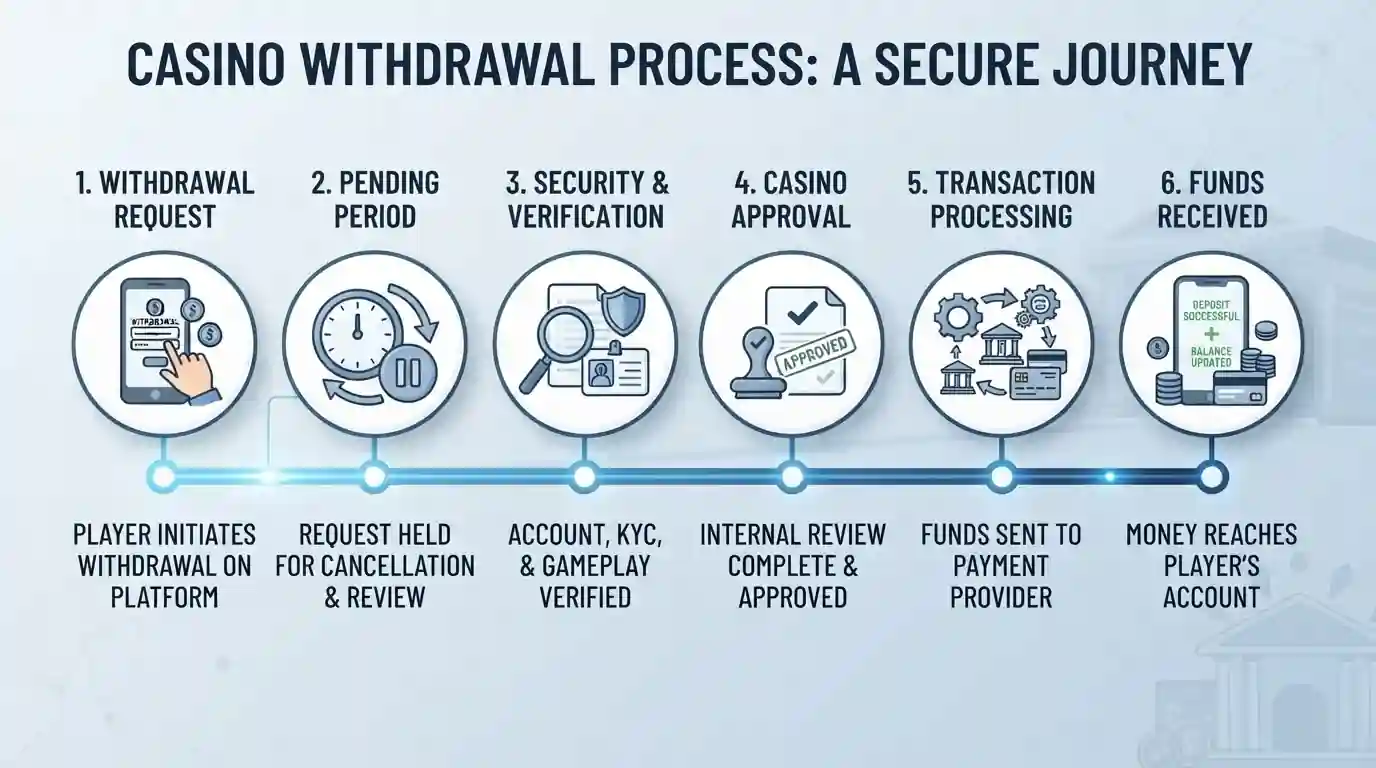
| Stage | Typical duration at AU-facing casinos | What actually causes the delay |
|---|---|---|
| First-payout verification | Same day to several days | Unclear photos, name mismatch, unsubmitted card crop |
| Operator processing review | 24–48 hours | Manual approval queue, bonus-wagering check, weekend backlog |
| Card refund settlement | 1–5 business days | Acquirer outbound rules, issuing bank posting schedule |
| Bank transfer settlement | 1–3 business days | Australian banking cut-off times, correspondent banks |
| E-wallet and crypto settlement | Minutes to under 24 hours | Network congestion, internal wallet batching |
What It Costs: Fees, Conversion, and the Cash-Advance Trap
Card deposits are free at most casinos because the operator absorbs the acquiring fee. Some do not, and the honest way to read that is: the cashier’s job is to make the cost invisible, and when it is visible, it is usually on small deposits. A surcharge of a few percent on a AU$10 transaction is a meaningful share of a AU$10 bankroll. It disappears entirely at a AU$500 deposit, which is not a coincidence about fee structure but about who complains.
The conversion cost is harder to see and lands on nearly everybody. An offshore acquirer settling an AUD transaction can carry a conversion spread in the region of 1.5% to 2.5% depending on your bank’s internal policy, and it appears on your statement as a slightly larger number rather than as a fee line. Put a AU$100 deposit through a card rail with a 2% spread and you have paid AU$102 to move money that never left the country. Run the same arithmetic on a AU$500 session funded in five small deposits rather than one large one and the spread is applied five times, which is how a string of cheap-looking card top-ups quietly becomes a 2% tax on the act of changing your mind. Nobody told you, because nobody had to.
Credit changes the arithmetic completely, and this is where the June 2024 policy direction reaches an individual player most directly even though the statute names licensed wagering operators. Card agreements in Australia routinely classify gambling transactions as cash advances. A cash advance starts accruing interest on the day of authorisation, with no interest-free period, and typically attracts a fee on top. On a facility charging roughly 20% to 22% annually, borrowed money in a slot machine is a math problem with a known answer, and the answer is not in your favour even if you get lucky on the spin. Debit sidesteps all of it, which is the single most useful thing you will read on a payments page that actually cares whether the transaction suits you.

Are there fees for using Mastercard at online casinos?
The casinos themselves usually charge nothing on a card deposit, though a minority add a surcharge around two to five percent, most often on low amounts. Your issuing bank can add a conversion spread near two percent when the transaction settles offshore, and a credit card will most likely treat the deposit as a cash advance, triggering a fee and daily interest from authorisation onward.
When the Transaction Fails: A Decline, Not a Mystery
A decline is a decision by one of three parties, and knowing which one said no saves an hour. The issuing bank says no most often, either because it blocks merchant category 7995 as a matter of policy, because a gambling block is switched on in the app, or because the amount tripped a fraud rule. The card network says no less often, usually on a cross-border or currency flag. The casino’s payment provider says no when the operator’s own risk rules reject the account or the amount.
Work through it in order. Check the banking app first for a merchant block or a gambling toggle, since turning one off is free and instant, and a surprising share of declines end there. Confirm available funds, because a card with a pending hotel hold has less room than the app’s front page implies. Retry once at a smaller amount; a AU$500 attempt that becomes a AU$100 attempt often goes through on the same account. If 3D Secure never appeared or failed to complete, that is a bank-side authentication problem, so call the number on the back rather than arguing with the casino’s live chat. And if the decline repeats across two different operators, the block is on your card, not on the site.
Then decide whether to keep pushing. If you are using credit and the transaction coded as a cash advance before being declined, the decline was doing you a favour. Switching to a debit card, or to a rail where the funding source is not a line of credit at all, is usually faster than resolving a merchant-category block, and it changes the risk profile of the whole session rather than just the payment attempt.

What do you do if your Mastercard deposit is declined?
Check your banking app for a gambling or international-transaction block and disable it if present. Confirm available credit or funds, then retry at a lower amount. If 3D Secure fails to load or rejects a correct code, contact your bank, since the block sits on their side. If two operators both refuse the card, fund by bank transfer, e-wallet or crypto instead.
What a Card Balance Buys You on the Other Side
Once the deposit lands, the funding method stops being visible to the game. Pokies, video poker, table variants and live dealer streams read only the account balance, so a Mastercard-funded balance plays identically to one funded by wire. The one exception is bonus eligibility, which is a cashier rule rather than a game rule.
Pokies carry the volume in Australia, and the practical difference between these sites is provider lineage rather than payment. RealTime Gaming venues such as Joe Fortune and Ozwin run a distinct, recognisable library and a promotion style built around free-spin drops. Curaçao generalists such as National, PlayAmo, Rocket and SkyCrown pull from Pragmatic Play, Hacksaw, Nolimit City, Play’n GO and the rest of the aggregation stack, which is where you get the jackpot-feature titles and the megaway descendants. BitStarz straddles both audiences. If you have a provider you actually enjoy, that filter is more useful than any ranking, because a cashier that accepts your card is worthless on a site whose lobby you find dull.

Live dealer tables are the one place a payment rail occasionally interferes. Some studios impose funding-source restrictions on high-stakes tables for collusion and anti-money-laundering reasons, and a handful of operators exclude live-dealer wagering from bonus playthrough, sometimes at a reduced contribution rate rather than a flat ban. Card-funded balances at the tables are not systematically blocked across these brands; a specific table refusing your stake is nearly always a table limit, not your bank. Baccarat and roulette variants carry the highest minimums, and a low-limit Mastercard deposit will not reach those seats at all. On mobile, the cashier and the live lobby both behave fine on modern Curaçao platforms, and SkyCrown and PlayAmo are the two built hardest around phone use, which matters when the studio stream is what you are actually paying for.
New Sites, and the Fine Print That Kills Card-Funded Bonuses
New AU-facing casinos arrive in waves and mostly share one payment profile: an aggressive minimum, a modern mobile cashier, and an unsettled payout reputation. SkyCrown is the youngest of the eight, and the honest advice about genuinely brand-new sites is narrower than the hype suggests. A site without a track record has not yet had to process many first payouts, which means its KYC process has not been stress-tested and its acquiring relationship has not been audited by anyone. Deposit small, cash out once before you commit a real bankroll, and treat a young brand’s withdrawal speed as unknown rather than fast.
Bonuses deserve the cynical reading, because the “free” money in a welcome package is a retention instrument with a price attached in the form of wagering requirements, capped wins and restricted funding methods. Card deposits are disproportionately affected for a business reason rather than a player one: acquiring fees are paid on every card transaction, bonus abuse across card rails is well documented, and refund reversibility gives a disputed deposit a route to being unwound that a wire does not. So the exclusion exists, and it hides in one line. Call that line what it is. A “free” offer that quietly bars the very rail it advertised has not failed to communicate, it has communicated very precisely to the part of the funnel where attention is lowest.
Before you deposit, find the promotion terms and search the funding-method paragraph. Look for a named exclusion list, which will say something about specific methods not qualifying, and check the maximum cashout on card-funded play, because a cap of AU$50 to AU$100 per transaction converts a “300% match” into a modest result. Wagering in the 35x to 45x band on a deposited-plus-bonus amount is the market norm and it is not a small number. If the exclusion line is missing entirely, that is not a guarantee of eligibility; ask support in writing and keep the answer.
How These Eight Were Chosen, and When Mastercard Is the Wrong Answer
The selection process here is deliberately payment-weighted, since that is what the query is about. A site had to take Australian players on an AUD cashier, list Mastercard at the front end rather than as an inherited network fallback, have operated long enough for its payout behaviour to be discussed, offer at least one non-card withdrawal route so a blocked card refund is not a dead end, and carry a licence with a traceable operating company. Bonus size, affiliate commission and game count ranked below those. Two brands that appear in every Australian listing were considered and dropped for the first criterion rather than the last, which is the sort of decision that never shows up on an affiliate page.
Responsible gambling sits inside the payment conversation rather than after it, and that placement is the point. Card spending is fast, frictionless and invisible until the statement, which is a poor combination for anyone whose play has started to chase. Deposit limits exist on these accounts and are worth setting on day one at an amount you already decided on. Cooling-off and self-exclusion tools are regulatory furniture in Australia now: BetStop, the National Self-Exclusion Register, covered 54,859 registrations from its introduction and 35,135 people held active exclusions as at 31 December 2025, and it applies to licensed online and phone wagering. The 2026 reform package strengthens BetStop’s operation and adds direct-marketing restrictions from 1 January 2027, including a ban on inducements pushed at at-risk customers. Free help is one phone call away through Gambling Help Online, 24 hours, and the fact that a deposit can be completed in nine seconds is not a reason to complete it.
Mastercard is not automatically the right rail. Industry estimates commissioned by Responsible Wagering Australia and reported in 2026 put the share of Australian wagering spend going to illegal offshore sites at 36%, up from 26% in 2021, with around AU$3.9 billion lost annually through those channels. That is a market reality about where money is going, and it also tells you that the payment rails are the pressure point regulators keep pushing on. The practical takeaway is not moral but operational. A deposit method that depends on a single offshore acquirer has a single point of failure, and the institutions that maintain that acquirer now have a statutory reason to look harder at the traffic. Picking the rail that fails last when one channel tightens is the boring, useful definition of flexibility in this market.
Choose the method by what you need this week.
| Method | Deposit speed | Cash out the same way? | Cost profile in AU | Best suited to |
|---|---|---|---|---|
| Mastercard debit | Instant to 1 min | Only where the acquirer allows refunds; otherwise wire | Usually no casino fee; possible conversion spread | Card-first players who want budget discipline |
| Mastercard credit | Instant, frequently declined | Same as debit, plus cash-advance coding | Fee plus daily interest from authorisation | Avoid for this purpose |
| Visa debit | Instant to 1 min | Similar refund limits as Mastercard | Comparable to Mastercard | Whichever card the cashier accepts today |
| PayID / POLi bank pay | Minutes | Back to your bank account, usually 1–3 days | Bank transfer pricing, often no surcharge | Clean paper trail, no card statement entry |
| E-wallets | Instant | Fastest exit, often under 24 h | Wallet fees and possible funding exclusion | Frequent small deposits and quick cash-outs |
| Crypto | 10 min or more on-chain | Fastest of all, hours | Network fee plus price movement | Players who need an exit when card refunds fail |
Two habits save more money than any choice on that table. Never deposit through a promotion you have not read the funding line of, and never treat the first withdrawal as a test you will take later. Do the verification before the second deposit, at an amount you can afford to leave sitting for a week, and you will learn everything you need to know about an operator’s payment behaviour while the risk is small.
Casino Deposit Methods Australia 2026 — PayID, POLi, PayPal & More
Content created by the «PayCasino» team